Hosted by Dr. Nicole Rivera and Dr. Nick Carruthers · Published 2026-09-09
Dr. Nicole: Hello everyone, welcome back to another episode of IntegrativeYou Radio. I am super excited about this topic, primarily because I got to wear my investigative hat last week. As Nick said, all he heard from my desk as I was in full investigative mode was, "Oh shit, no!" I was piecing every dot together for a client who presented to us with POTS syndrome.
Don't get me wrong, when people come to us with a specific diagnosis like POTS, we do not look at them as that label or that diagnosis. We're always thinking, "What's the true root cause?" A lot of these diagnoses are just a description of your symptoms. If we can name your symptoms and put them inside a diagnosis, then there is a medication, a surgery, or a procedure that goes along with that.
I want you guys to understand why the system is built the way that it is. This is one of the reasons why people sometimes get denied when they go get blood work or a procedure, because they find that it wasn't medically necessary or it didn't coincide with a proper, quote-unquote, diagnosis. There are a bunch of people that aren't doctors who make these rules. It works because people want answers. When you are ill for so long, you just want to know what it is. When it goes on so long, you are almost relieved to say, "I have POTS. Okay, there's a reason, there's an answer." But sadly, it's not giving you the true root. It's just putting a label on you that now has to be managed through the textbook of how POTS is treated.
Our investigative process, my investigative process, is to really look at the big picture and say, "Is this POTS? Is it something else? If it is POTS, what is the actual root cause?" There were a lot of interesting things that I uncovered, which we're going to talk about today. For those of you listening to us on your phone or on our podcast via Podbean, Spotify, iTunes, all of those things, you can always listen to this later on YouTube because we post in both places. There are a couple of visuals that will help you really understand the information we're going to be talking about today, because it's a bit of an anatomy thing. But overall, if you're just listening, you're going to get the gist of it. The goal is to open your eyes to the possibilities, give you answers around why you might be experiencing very particular symptoms when it comes to POTS, and also to give you some insight on what to do next.
Before I dive in, Dr. Nick, do you have anything to share? Or are you just going to let me roll?
Dr. Nick: I'm just going to let you roll for a little bit. I've been taking notes as usual. I come very well, not prepared. So I've just been taking a lot of notes on my thought process, which is completely different than your thought process, on the mind-body correlation and creation of the symptoms that one feels and experiences throughout the body.
Dr. Nicole: For those of you who are new, Dr. Nick and I work together, but we bring different things to the table. I am the master investigator; it's my jam. I love it. Finding the root cause is everything to me. Dr. Nick assists in that process because as we navigate our testing process, one of the very unique things that we do is DNA testing. Dr. Nick then establishes what's stressing the DNA, and he has created a technique to figure out exactly how to neutralize the stress on the DNA. Your protocol, your recommendations, your healing plan is actually completely curated to you, to your DNA, which is one of the reasons why we get great results. But if you don't know the root cause, then that part is irrelevant.
Dr. Nick has a specialty in really helping with the mind-body connection to the symptoms that we experience. I work with a lot of our clients on vision, helping them see what life is going to be like when they reclaim their health. Nick is really fantastic at helping them to work through the things that got them where they are in the first place or potentially played a role in the development of these symptoms. Because again, if you're new here, you might not understand that in this moment. The only thing that I feel like is being peddled all over the internet is nervous system dysregulation. Listen, everyone's stressed out. Sadly, that's the world we live in. But in all the years we've been doing this, we have not seen a series of symptoms or a significant diagnosis like POTS without discovering that there is a significant emotional event, adversity, or a series of events that happens leading up to the decline of health.
Dr. Nick: It's easy for us to say and understand, but coming from the person that doesn't deal with this every single day and every single moment, there's really no difference between the body and the mind. We think that they're separate, but they're kind of like a musical scale where you think that the notes are separate, but actually when you get to the end of one octave and the start of the other, they overlap each other. That's how the mind and the body are. They're really intertwined. You can't have a dysregulated body without a dysregulated mind, and you can't have a dysregulated mind without having a dysregulated body. The awareness will be, "Oh, I have these mental issues," or "I have these body issues," but really there are issues in both. There always is; they're entangled. Of course. This is being proven by neuroscience on the regular nowadays. It's just sadly it hasn't really been brought into conventional medicine because everything is a bunch of separate specialists, and it's thought everything is these separate entities.
Dr. Nicole: We will no longer derail, but for those of you that have POTS, or know someone with POTS, there's a variety of different symptoms that come up. A lot of times, you don't have two people with the diagnosis of POTS and it looks exactly the same. Their history sure as heck doesn't look exactly the same. This is classified as Postural Orthostatic Tachycardia Syndrome. Some people have a racing heart, some people don't. Some people have a racing heart occasionally, some people don't. The other thing is that some people get up and they start to get off kilter, they get lightheaded, dizzy, some faint. It depends on the severity of the situation and it depends on the root causes. This is really congruent with all diagnoses. This is why they look different amongst people, because it can vary person to person depending on what is truly at the root.
## Client Case Study: POTS and the Root Cause [09:12]
Dr. Nicole: This individual that came to us, she is a young woman in her early 20s and in a wheelchair. She literally graduated from college with a very prestigious degree. She said it was one of the hardest things that she ever did, and it was a very, very stressful time for her. Then fast forward, she ended up in the hospital. Her right ovary was taken because it was completely necrotic. What that means is there was no blood flow to that ovary. It turned black, the tissue was dead, and they had to remove it. The typical answer for that is torsion. If something twists and cuts off blood flow, then that could be the reason why that happened. That was what she was told.
Fast forward, then we start to have these different symptoms. She can't get up for long periods of time in a standing position without getting lightheaded, dizzy, nauseous, and feeling extremely poor. Fast forward, now we're to the point that she can't even get up for a minute to two minutes, and she's pretty much consistently in a seated or lying down position. Thinking about the catastrophic effect on this person's life, who's really just starting her life, and being labeled with POTS and being told that there aren't really many options for her.
They ended up, I've worked with the mother before. They reached out and we said, "Just let us investigate and see what's going on." So I'm doing our DNA testing. I'm going to give you just a quick understanding of this. When you go and you get blood work, and let's say a virus comes up, the question you might have to your doctor is: "Is the virus active? Is it not active? What is it doing? What problems is it causing? What symptoms is it causing?" Same thing. Your liver enzymes are elevated. "Okay, what's causing my liver enzymes to be elevated? What is this doing to my health? What symptoms is this causing me?" A lot of times they don't have the answer to that. They just say, "It must be hereditary genetic." Not true.
## Uncovering the Clotting Disorder and Nutcracker Syndrome [12:00]
Dr. Nicole: Anyhow, when we do our DNA testing, what we're doing is we're looking to piece the puzzle together with the different labs that we see. In running labs for this individual, there were a multitude of blood clotting factors that came up. The start of what's called antiphospholipid syndrome, and there was also presence of an autoimmune against the platelets. These are two contradictory things because if you have an attack on your platelets, you're going to have very thin blood and the risk of bleeding out. But when you have the very particular combination that this person had—she had a combination of antiphospholipid syndrome, a combination of an autoimmune against platelets, and a combination of a positive ANA—this is actually showcasing that there is increased hypercoagulability, also known as blood clotting, that's happening. That was the first part. I'm like, "Okay, this can definitely cause some problems with what she's experiencing."
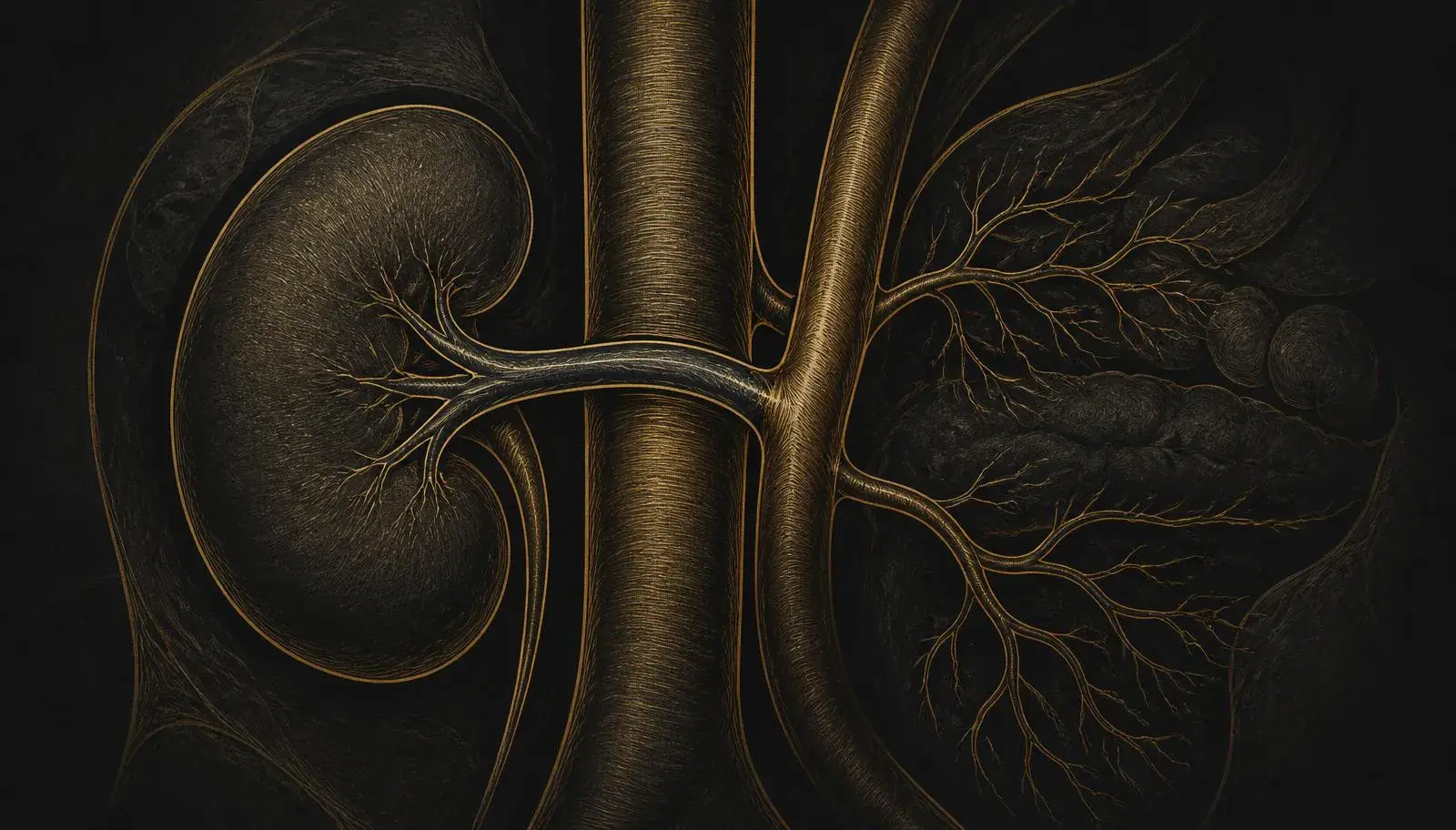
As we then started to navigate our other piece of data, which is our DNA testing, one of the primary things that I saw was a varicose dilation of the left kidney in particular, the vein going to the left kidney. When you guys look at people's legs, you see it a lot in older people, and they have those big, puffy veins that you could see they're bulging out. That's a varicose vein. You can have varicose veins inside of your body. You could have varicose veins that are going to different organs. So this individual particularly had this varicose vein and inflammation in the left kidney and the left vein of the kidney.
As I continued my investigative process, it turns out that she actually had something called Nutcracker Syndrome. This is the part where I mentioned that being on YouTube might help a little bit because I'm going to just give you guys the verbal. If you take your hand flat, which of course I have ink on my hand, you take your hand flat and then you create a C with your other hand. What you're going to be showcasing is the flat hand is something called your aorta. The C-shaped hand, connected to your flat hand, is going to be your superior mesenteric artery. Overall, the only thing you need to know is that inflammation in both of those is going to smash the left, particularly left, vein that is coming from the left kidney. Not the right, the left.
Then I take this a step further, and I'm like, "Wait, which ovary did she have removed?" I go back into her history. "Holy shit, it's the left ovary!" When you look at the anatomy, the vein to the left ovary is directly connected to the vein of the left kidney. So essentially, what's happening is that she is having clots in the vessels of her liver. She's having clots in the vessels associated with her aorta and the mean vessels in the thorax—the what am I trying to say? That's not a scientific term. Your thorax, it's pretty much like where your heart and your lungs and everything is. So she's having this blood stagnancy because of these clots that are building up. She has a clot that's showing up directly in the venous system of her kidney. Now this is creating all of this back pressure of blood, and it's also occluding blood from other parts of the body.
Essentially, this blood clotting disorder started and the ovary was the first to be compromised. Now, as it has worked its way up to completely compromising the left kidney, the POTS symptoms, I should say, have become extremely problematic. This is huge because feedback number one for this person was the loss of the ovary. But she was told it's just torsion. That is all. There was no proper due diligence to check if there was clotting or if there were any other possible root causes. She was given a series of medications and shipped on her way.
Then we have POTS syndrome. Because she had the textbook symptoms, she's just, "You have POTS, that's all." No connection of the two, and no answers as to what the fuck is going on. She's really, really smart, this girl. She goes, "Are you telling me that what happened to my ovary could happen to my kidney?" I'm like, "It could, but we now have this data and we now have solutions. So no." But if we did not do this due diligence of understanding all of the pieces and understanding the root cause, that could have been part of your future.
Dr. Nick: Your smirk, what do you have to say? Mm-hmm. I'm always just writing down notes of words you say. I'm always looking at everything, how energy first flows through, not getting too deep, but from the spirit to the mind to the body. Paul Bragg, he was really amazing at understanding the bigger picture and how the body actually worked, and he said that "The spirit guides the mind, the mind dictates the body." So everything that the mind perceives, that stress actually goes and gets processed and expressed by the body.
You directly said that looking at the autoimmune issues, the varicose veins, that there is this huge back pressure buildup of the blood. The blood is your circulation of love. It's your life force around the body. When you look at the venous system and the artery system, arteries are pumping blood out, veins are bringing blood back. So when the veins are the issue, there's an issue of bringing love back into yourself, back into your heart system. That back pressure of blood buildup shows that there is an extreme back-looking at the past buildup of pressure that hasn't been dealt with for a long time. When you think about pressure, pressure is always something that we perceive when we're trying to achieve a form of success that's actually not in alignment with who we are. It's not authentic. So the body is always going to express symptoms as a feedback mechanism for the mind to be able to use as a teacher, as an opportunity for us to get back into alignment, to get back into what some call the flow state when we look at athletics and things like that. But it's really just helping us to become the...